
Foreword
Ireland has a strong international reputation as a country committed to human rights, equality and the rule of law. We continue to perform well by most international measures, and successive Governments have placed support for multilateralism and international law at the heart of Irish foreign policy. That deserves recognition.
But we cannot afford complacency. We are living through an exceptionally challenging period for human rights. War continues on Europe’s eastern borders and across the Middle East. The international institutions created to protect human rights and uphold international law are under strain. Some long-standing partners have retreated from multilateralism or become openly hostile to international accountability mechanisms. Across Europe, anti-rights movements are growing in influence, while economic competitiveness, migration control and security are increasingly invoked to justify weakening established protections.
Ireland is not insulated from these pressures. Indeed, one of the central questions facing us is whether we can maintain our commitment to human rights and international law when doing so becomes politically or economically difficult. Principles matter most when they are tested.
Domestically, the picture over the past year has been mixed. This report identifies genuine progress, but also stagnation in important areas and, in some cases, developments that risk diminishing rights and protections.
There have been welcome advances in Ireland’s equality infrastructure, most notably in publication of the first National Equality Data Strategy, which provides an important foundation for understanding and responding to inequality and discrimination. At the same time, much-needed reform of Ireland’s equality legislation has advanced too slowly, while deadlines to transpose important EU equality measures have been missed.
There is also cause for concern in relation to the rule of law. At IHREC we have observed increased use of accelerated legislative processes, sometimes involving significant and disparate measures with limited opportunity for pre-legislative scrutiny. Effective parliamentary scrutiny should not be seen as an administrative obstacle to government action. It is one of the democratic safeguards through which rights are protected and better laws are made.
Socio-economic pressures have also intensified. Record levels of homelessness, housing insecurity, energy poverty and growing cost of living pressures sit uneasily alongside Ireland’s considerable national wealth.
The findings of IHREC’s Annual Poll 2026 give us an important insight into how these developments are experienced by the public. Almost two in three people (65%) say they have a strong understanding of human rights, while 48% say the same of equality and anti-discrimination measures. The overwhelming majority (84%) believe that everyone should be treated equally regardless of who they are or where they come from. These are encouraging findings as they demonstrate that the values underpinning human rights and equality continue to command broad public support.
On the other hand, other findings should greatly concern us. Only 39% now believe that everyone in Ireland enjoys the same basic human rights, down from previous years. The proportion believing that they have equal opportunities to get ahead in life fell sharply, from 62% to 53%. Most strikingly, only 26% believe that efforts to fight discrimination in Ireland are effective, compared with 40% just one year ago.
There is a message in these figures that should not be ignored. The Irish public continues to believe strongly in the principle of equality, but confidence that equality is being delivered in practice is weakening.
We see a similar gap in relation to economic and social rights. Some 87% of people are worried about the cost of living, while only 12% believe that Government is doing enough to address those pressures. Just 11% believe that Ireland’s wealth is distributed fairly. Yet there is overwhelming agreement about what Government should seek to provide: 94% consider affordable and accessible healthcare important, 91% affordable and accessible housing, 91% adequate pensions and 90% adequate earnings.
This gap between aspiration and lived reality is a recurring theme throughout this report. Ireland frequently has strong principles expressed in law, policy and strategy. Too often, however, implementation is delayed, fragmented or frustrated by competing political and economic pressures. Rights which exist on paper must ultimately be measured by their impact on people’s lives.
That challenge is particularly evident in the areas of racism, hate and social cohesion. Public support for equal treatment remains strong, and there are some encouraging signs in attitudes towards diversity. Yet racism continues to be experienced disproportionately by non-Irish and non-white communities. 12% of respondents reported experiencing racism over the previous 12 months, rising to 25% among non-Irish, and 46% among non-white respondents.
We have also witnessed the growing influence of hate, misinformation and disinformation in public debate. Racism, misogyny, homophobia, transphobia and other forms of identity-based hostility are increasingly creeping into public discourse, and when people are intimidated or driven from public life because of who they are, the consequences extend beyond those directly targeted. Our democracy, civic space and social cohesion are undermined by these trends.
Migration and international protection have become particular pressure points. Major reforms to the asylum system have placed increasing emphasis on accelerated procedures, returns, and migration control at the same time as there are significant pressures and gaps in accommodation, legal safeguards, and independent oversight. Progress in protecting and identifying victims of trafficking has also been inadequate.
Disability rights, meanwhile, have seen substantial policy and legislative activity, including a new national strategy and the beginnings of long-awaited legislative reform, but significant barriers remain in independent living, accessibility, safeguarding and community-based supports.
These issues do not exist in silos. Housing insecurity, poverty and pressure on public services can create fertile ground for misinformation and divisive narratives which encourage people experiencing genuine hardship to see other structurally vulnerable groups as the cause of their difficulties. That is why the effective realisation of economic and social rights is also a question of social cohesion.
Ireland is a wealthy country, one of the wealthiest in the world. That gives us both the capacity and the responsibility to do better. National prosperity should be judged not only by economic metrics, but by whether people can live with dignity, participate equally in society, and trust that the institutions of the State will endeavour to vindicate their rights.
When wealth exists alongside inequality, homelessness and exclusion, the social fabric begins to fray. Conversely, when human rights and equality are translated into tangible improvements in people’s lives, they strengthen the bonds that hold a society together.
The challenge for the coming year is therefore not simply to adopt more strategies or make more commitments. Rather it is to close the gap between principle and practice, between commitment and implementation, and between our considerable national resources and the lived experience of the people whose rights those resources should serve.
Liam Herrick
Chief Commissioner
Who we are
The Irish Human Rights and Equality Commission (IHREC) is Ireland’s independent National Human Rights Institution and National Equality Body.1 We protect and promote human rights and equality in Ireland.2
We are also the Independent Monitoring Mechanism for Ireland under the United Nations Convention on the Rights of Persons with Disabilities3 and the Independent National Rapporteur on the Trafficking of Human Beings,4 and we will be assigned the role of the Co-ordinator of the National Preventive Mechanism under the Optional Protocol to the Convention against Torture,5 pending ratification. Alongside Northern Ireland’s human rights and equality bodies, we have a mandate to consider and report on human rights and equality issues with an island of Ireland dimension.6 We also have legal powers under the Gender Pay Gap Information Act 2021,7 and an imminent fundamental rights role in relation to the EU Artificial Intelligence Act.8
We are mandated to keep under review the adequacy and effectiveness of law and practice in the State relating to the protection of equality and human rights; and to make recommendations to the Government in relation to the measures that we consider should be taken to strengthen, protect and uphold equality and human rights in the State.9 We assist public bodies with their statutory obligations under the Public Sector Equality and Human Rights Duty to have regard to the need to eliminate discrimination, promote equality and protect the human rights of their staff, customers, service users and everyone affected by their policies and plans.10
In our Strategy Statement 2025-2027, we have prioritised the following aims within the context of our work:
- Developing robust responses to current and emerging threats to human rights and equality;
- Enhancing accountability mechanisms;
- Strengthening the human rights and equality infrastructure in the State;
- Fulfilling our international role as part of a global network of National Human Rights Institutions and National Equality Bodies; and
Operating as a model organisation for implementing human rights and equality in practice.11
1 Established under the Irish Human Rights and Equality Commission Act 2014.
2 See our recently published Strategy Statement 2025–2027: IHREC, Strategy Statement 2025-2027 (2025).
3 Section 103 of the Assisted Decision-Making (Capacity) (Amendment) Act 2022.
4 IHREC, Commission Takes on New Role as Ireland’s National Rapporteur on the Trafficking of Human Beings (2020).
5 To be provided under the Inspection of Places of Detention Bill, when enacted.
6 We work with the Northern Ireland Human Rights Commission (NIHRC) in the Joint Committee, as set out in the Belfast Good Friday Agreement. Following the UK’s withdrawal from the EU, we also comprise the Article 2(1) Working Group of the Dedicated Mechanism, along with the NIHRC and the Equality Commission for Northern Ireland (ECNI).
7 Gender Pay Gap Information Act 2021.
8 Article 77 of the European Union Artificial Intelligence Act. Department of Enterprise, Trade and Employment, Minister Calleary announces key milestone in the implementation of the EU regulation on AI (31 October 2024).
9 Section 10(2) of the Irish Human Rights and Equality Commission Act 2014.
10 Section 42 of the Irish Human Rights and Equality Commission Act 2014.
11 IHREC, Strategy Statement 2025-2027 (2025).
Ireland in International and European contexts
International
The international multilateral human rights system remains under exceptional pressure. Armed conflicts, geopolitical fragmentation, growing autocratisation around the world,12 and reduced support for multilateral cooperation are placing more strain on the post-war framework than it has ever endured.
Ireland is therefore entering into a particularly difficult period for foreign policy, where the tension between principled support for human rights and international law and competing economic and strategic interests is becoming increasingly difficult to sustain. We are concerned by the apparent shift in tone from political leadership, in Ireland and internationally, in which economic and security considerations are increasingly presented as justifications for weakening or qualifying established obligations under international human rights law.
Growing challenges to international accountability mechanisms illustrate this trend. In September 2025, the US introduced sanctions against judges of the International Criminal Court, and these attacks continued into 2026, with US Secretary of State Marco Rubio describing the ICC as a threat to ‘every aspect of the United States’ political and legal system’.13
Ireland is not immune to these pressures. Our economic reliance on multinational investment creates vulnerabilities to external economic and political pressure, potentially constraining our range of principled foreign and domestic policy. The debate around the Occupied Territories Bill (OTB) illustrates this. While we welcome the enactment of the OTB, we have repeatedly stated that the omission of services means that the legislation falls short of our international legal obligations.14 The US Embassy’s subsequent warning that the legislation risks ‘real unintended consequences’15 demonstrates the pressures that can arise when human rights and economic interest intersect.16
In December 2025, we hosted Dr. Ammar Al Dwaik, Director General of the Palestinian Independent Commission for Human Rights (ICHR), together with ICHR member Diana Buttu. During the visit, they emphasised the obligations of third-party states, including Ireland, to take substantive action to respond to genocide and the unlawful occupation of Palestinian territory. A clear message from the visit was that while Irish solidarity with the Palestinian people is deeply valued, there is an expectation of concrete action from the Irish State. It also demonstrated the growing pressure on Ireland to ensure that its stated commitment to international law is reflected in domestic and foreign policy.
The United Nations system is under immense stain, with the UN80 initiative, launched in March 2025, coinciding with deep cuts in funding to the human rights pillar of the UN. In February 2026, the State announced additional funding for the Office of the United Nations High Commissioner for Human Rights (OHCHR), bringing Ireland’s total voluntary support to OHCHR in 2026 to over €7.5 million, making Ireland the eighth largest donor to OHCHR.17 Ireland’s continued strong support for the UN’s human rights pillar is much needed and appreciated by those, like us, that believe in the value of the multilateral human rights system.
Ireland is currently seeking election to the UN Human Rights Council (HRC) for a three-year term, starting from January 2027. The stated priorities include supporting civil society and human rights defenders; advancing women's rights and gender equality; defending the rights of LGBTIQ+ persons; promoting the right to food; and protecting the rights of persons with disabilities in conflict. If elected, membership of the HRC will provide Ireland with an important platform to demonstrate real leadership on these issues. We particularly welcomes Ireland’s commitments on gender equality and LGBTIQ+ rights, given the growing backlash on women’s rights, sexual and reproductive health, and LGBTIQ+ rights observed within various UN forums.
Europe
Ireland assumed the rotating Presidency of the Council of the European Union on 1 July 2026. The priorities for the Presidency include competitiveness, upholding the indispensable foundational values of the EU, and protecting citizens through security.18 We welcome the express commitment to human rights, equality, the rule of law, freedom, and democracy as the foundation of the EU, as well as the commitment to gender equality, the rights of LGBTIQ+ persons, and the participation of disabled people in Europe’s social and economic life.
The Presidency takes place against a difficult political backdrop in Europe. Far-right parties have increased their influence in the European Parliament, and the cordon sanitaire that historically limited mainstream parties’ cooperation with the far-right has weakened. We are concerned that this will have negative consequences for efforts to advance environmental protections, equality, labour rights, and ensuring fundamental rights are at the heart of European policy and law-making.
A related development has been the growing emphasis on European ‘competitiveness’ and regulatory ‘simplification’. Improving the Single Market and boosting the efficiency of European enterprise is a legitimate objective, but often simplification is merely a cover for deregulation. Recent ‘Omnibus’ legislative initiatives, in an effort to ‘simplify’, have sought to amend multiple pieces of EU legislation simultaneously, raising concerns around the quality of law-making, the process of consultation, and the potential impact of proposed changes on rights protected by the Fundamental Charter of Rights. For example, the Digital Omnibus will amend the EU’s artificial intelligence (AI) framework before it even comes into effect, delaying regulation of high-risk AI systems and minimising the role of oversight bodies.19 This illustrates just one example of how efforts to boost innovation and competitiveness through simplification can come at the expense of effective rights protections.
Migration and asylum policy has become another significant pressure point for the European human rights system, in part due to the growing influence of the far-right. In December 2025, this led to calls from a group of European states for changes in the interpretation and application of the European Convention on Human Rights (ECHR) to ‘better address the challenges of migration’.20 Human rights institutions across Europe expressed concern that this initiative could seriously undermine the Convention and the European Court of Human Rights Ireland’s decision to join that initiative was regrettable. Fortunately, the more explicit negative consequences of the initiative were avoided when the Council of Europe’s Committee of Ministers reaffirmed member states’ commitment to the Convention and European Court.21 However, the episode remains deeply concerning, as some actors across Europe have their sights set on reform or withdrawal from the Convention. The issue has a particular constitutional and historical significance for Ireland, as the Convention is a foundational constitutional baseline and binding safeguard that underpins the 1998 Belfast (Good Friday) Agreement and post-Brexit arrangements on the island of Ireland. We are strongly of the view that there can be absolutely no backsliding on our commitment to the European Convention and Court of Human Rights.22 Doing so would risk unravelling the human rights framework that underpins peace on this island.
12 V-Dem Institute, Democracy Report 2026: Unravelling the Democratic Era?
13 Carnegie Endowment, 15 July 2026, ‘What’s Driving the Trump Administration’s Push to Dismantle the ICC?’
14 Irish Examiner, 27 May 2026, ‘Excluding services from Occupied Territories Bill has ‘no legal basis’, says IHREC.
15 The Journal, 24 July 2026, ‘US embassy says Occupied Territories Bill ‘risks real unintended consequences’ and is ‘unhelpful’.
16 The ongoing controversy over Aughinish Alumina is another example.
17 As of 31 July 2026. See Voluntary contributions to OHCHR in 2026.
18 Priorities of the Irish Presidency of the Council of the EU
19 European Parliament Legislative Train Schedule on the Digital Omnibus on AI
20 RTE, 11 December 2025, Ireland signs joint statement for ECHR to address migration
21 IHREC, 15 May 2026, IHREC welcomes reaffirmation of European human rights system following Council of Europe declaration on migration
22 IHREC, 13 February 2026, Ireland’s Commitment to the European Convention on Human Rights in the Context of Council of Europe Initiatives on Migration.
Key developments for IHREC's role
The previous year has seen several developments affecting our institutional role as Ireland’s National Human Rights Institution (NHRI), National Equality Body, and Independent Monitoring Mechanism under the UN Convention on the Rights of Persons with Disabilities (UNCRPD).
In October 2025, ten new members were appointed to our statutory Disability Advisory Committee following a public selection process. The Committee plays an important role in ensuring that the perspectives and lived experiences of disabled people are mainstreamed into our work and our role as Ireland’s Independent Monitoring Mechanism under the UNCRPD.23 We also welcomed six new Commissioners in November 2025.24
In April 2026, the Global Alliance of National Human Rights Institutions (GANHRI) re-accredited IHREC with ‘A’ status.25 The re-accreditation recognises our continued compliance with the Paris Principles governing the independence and effectiveness of National Human Rights Institutions. Retaining our ‘A’ status means that we can independently participate in United Nationals human rights mechanisms, including through speaking rights at the Human Rights Council, and can exercise voting rights within regional and global NHRI networks.
Our statutory responsibilities also continued to evolve. The EU Directives on Standards for Equality Bodies establish new statutory minimum standards relating to the independence, powers, resources and functions of National Equality Bodies across the EU, including IHREC. Unfortunately, Ireland failed to transpose the Directive by the June 2026 deadline and the European Commission subsequently launched infringement proceedings. We continue preparing for enhanced responsibilities under the Directives and supports a swift and comprehensive transposition of the Directives.
We are also preparing for further monitoring and oversight responsibilities under the EU AI Act and, subject to enactment of necessary domestic legislation, as Coordinating National Preventative Mechanism under the Optional Protocol to the UN Convention Against Torture. These expanded responsibilities reinforce the importance of IHREC in Ireland’s human rights and equality framework, and it is essential to ensure that we have the independence, powers, and resources required to adequately discharge our growing mandate.
23 IHREC, 1 October 2025, New Members Appointed to Commission’s Disability Advisory Committee
24 IHREC, 6 November 2025, New Commission Members Proposed for the Irish Human Rights and Equality Commission
25 Global Alliance of National Human Rights Institutions Report and Recommendations of the 47th Session of the Sub-Committee on Accreditation
Equality and non-discrimination
There were important advances in Ireland’s equality infrastructure over the previous 12 months, most notably in the launch of Ireland’s first National Equality Data Strategy, indications that the State is advancing implementation of equality budgeting, and the launch of the National Strategy for Women and Girls. However, there has been little progress on advancing much-needed reform of Ireland’s equality legislation, and several deadlines to transpose EU equality law obligations have been missed. Most concerningly, public confidence in the State’s efforts to tackle discrimination, and the belief that there are equal opportunities for getting ahead in life, have both fallen sharply.
I have equal opportunities for getting ahead in life, like everyone else
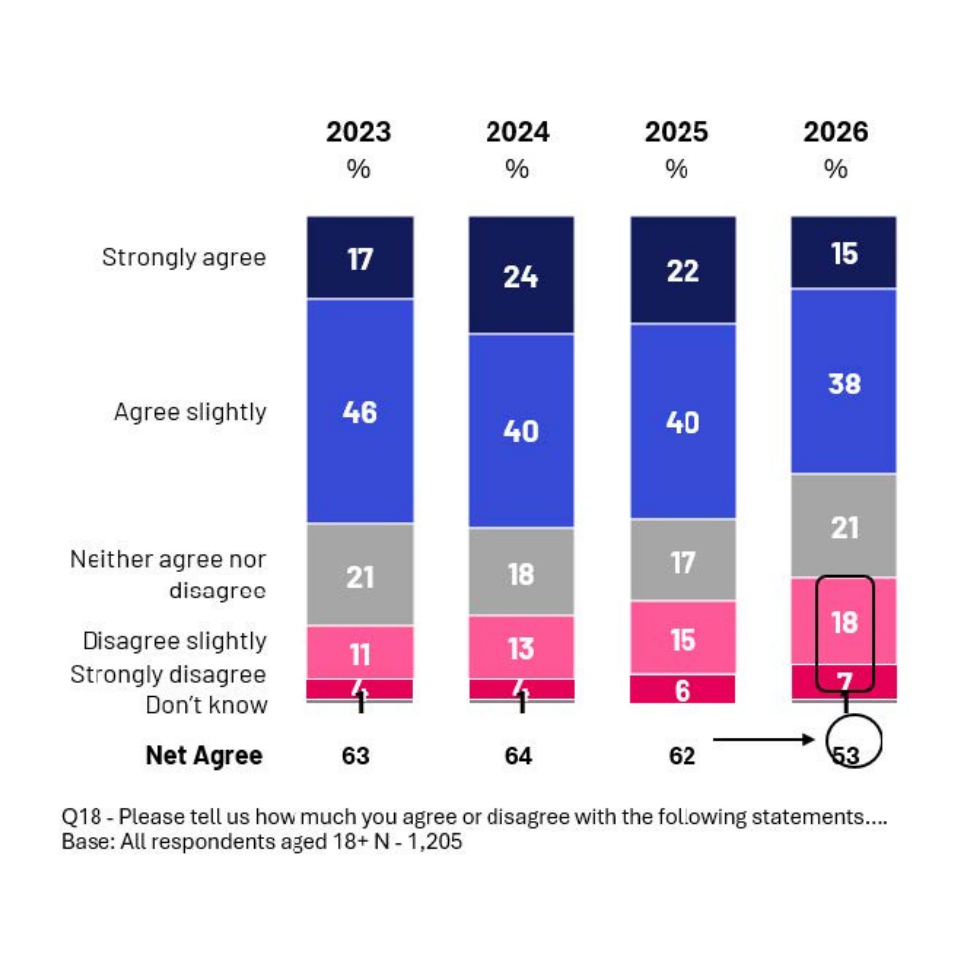
According to IHREC’s Annual Poll 2026, public perception of the state of equality and the effectiveness of anti-discrimination measures has deteriorated significantly.
Just 53% of respondents agree that they have equal opportunities to get ahead in life, compared with 62% in 2025. There was an even sharper decline in perceptions that efforts to tackle discrimination are effective: only 26% in 2026 agreed that efforts are effective, down from 40% in 2025, while the proportion considering them ineffective increased from 26% to 36%. Women and those who have witnessed racism or discrimination were significantly more likely to view efforts as ineffective. These findings provide important context in which to consider the main developments in equality policy and legislation over the past year.
Efforts to tackle discrimination in Ireland are effective
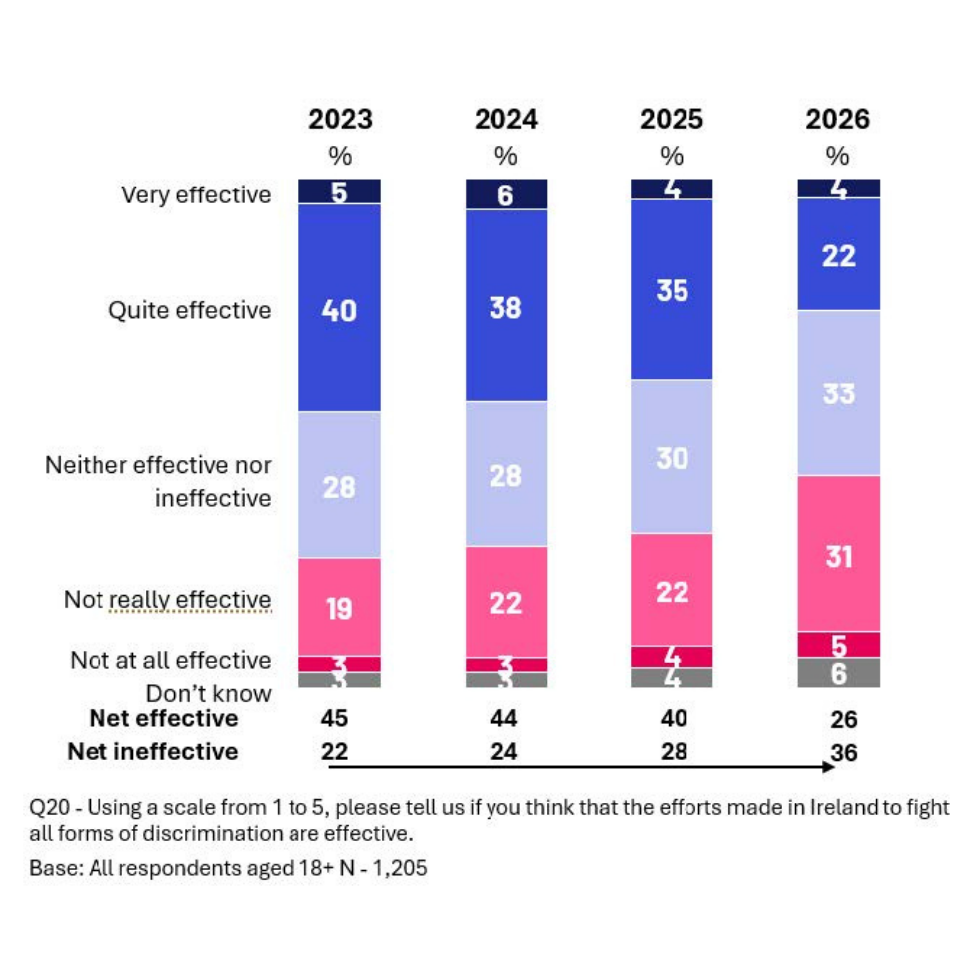
Equality law reform
Progress on reform of Ireland’s equality legislation remains concerningly slow. A comprehensive review of the Equality Acts began in 2021, and the General Scheme of the Equality (Miscellaneous Provisions) Bill was published in 2024. However, this legislation has not advanced and five years on from the announcement of the review, equality law reform has yet to substantially progress. A key outstanding issue is the proposed introduction of socio-economic status as a protected ground. IHREC and civil society organisations have strongly advocated for its inclusion, and the Oireachtas Committee examining the General Scheme recommended its inclusion following pre-legislative scrutiny in October 2025.26
The need for wider reform has also been reinforced internationally. In its July 2025 Concluding Observations, the UN Committee on the Elimination of Discrimination against Women (CEDAW) called on Ireland, as a priority recommendation for follow-up by May 2027, to expedite the Equality (Miscellaneous Provisions) Bill and ensure protection against a broad range of internationally recognised and intersecting forms of discrimination.27 Continued delay in progressing the Bill leaves significant gaps in Ireland’s equality framework unresolved.
Equality data and budgeting
On a more positive note, Ireland’s first whole-of-government National Equality Data Strategy 2026-2031 was launched in January 2026. This strategy will improve the collection, disaggregation, and use of equality data and will help Government and other actors to better identify where interventions and supports are most needed and their effectiveness. We were a member of the Equality Data Strategy Working Group that supported the development of the Strategy. Robust equality data is essential for making inequality visible and holding public bodies accountable to their equality obligations; however, its usefulness will depend on robust implementation and consistent and proper use of the data produced.
Relatedly, there has been some progress on equality budgeting. In December 2025, the Department of Public Expenditure and Reform published a working paper on Equality and Public Policy, outlining how equality considerations can be embedded within the budgetary process.28 This complements our May 2026 policy statement on human rights and equality budgeting, which called for human rights budgeting to be embedded alongside existing equality-budgeting processes.29 Taken together, these developments have the potential to strengthen evidence-based policy-making and improve accountability for the distributional impact of public spending.
EU Standards for Equality Bodies
On the other hand, progress on implementing the EU Directives on Standards for Equality Bodies has been disappointing. Ireland missed the 19 June 2026 deadline for transposition, leading the European Commission to commence infringement proceedings announced on 15 July. The formal notice procedure allows for two months for Ireland to reply and complete the transposition of the Directives, otherwise the Commission may move to a next step of the infringement procedure.30 Ultimately the infringement procedure can possibly lead to proceedings in the Court of Justice of the European Union and significant monetary penalties.
We have also raised concerns regarding the State’s proposed approach to transposition. The use of secondary legislation would allow only those elements capable of being introduced through existing statutory powers to be implemented immediately, leaving other elements dependent on future primary legislation. We wrote to the Minister for Children, Disability and Equality in June 2026 outlining these concerns.31 The delay is particularly significant in the context of the wider lack of progress on reform of the Equality Acts. The Department has indicated that elements of the Directives requiring primary legislation may be considered through the Equality (Miscellaneous Provisions) Bill. The cumulative effect risks further delaying the comprehensive strengthening of Ireland’s equality framework. We support the swift and comprehensive transposition of the Directives across the full scope of Irish equality law.
Gender Equality
The National Strategy for Women and Girls 2025-2030 was published in November 2025, followed by an Action Plan in August 2026.32 The Strategy provides a renewed framework for advancing gender equality. However, while some actions include delivery timeframes, many others do not, and the absence of clear key performance indicators risks making meaningful assessment of implementation difficult. Important issues including redress for survivors of institutional abuse, reform of equality legislation, human trafficking, and women in prison are also not substantively addressed. Despite State commentary at the June 2025 CEDAW Review that the delayed publication of the National Strategy for Women and Girls provided an opportunity for Ireland to domestically implement the UN Committee’s recommendations, this opportunity has been missed.
The launch of the voluntary Gender Pay Gap Portal in November 2025 provides greater public transparency around employers’ gender pay-gap reporting.33 However, progress on wider pay equality measures has been undermined by Ireland’s failure to transpose the EU Pay Transparency Directive by the 7 June 2026 deadline. The Directive provides for measures including greater salary transparency, gender-neutral recruitment practices and enhanced information rights for workers. At the time of writing, there is no timeline for domestic implementation, and businesses will not be penalised for failing to comply in the interim. Failure to meet the transposition deadline is particularly disappointing given Ireland’s stated commitment to leadership on gender equality during its EU Presidency.
LGBTIQ+
In July 2026, the President signed into law legislation to provide for a Disregard Scheme for historical convictions relating to consensual same-sex activity prior to decriminalisation in 1993. The scheme, which has been proposed for almost a decade, represents an important step towards recognising the historical injustice experienced by gay and bisexual men in Ireland.34 This scheme should now be implemented without further delay.
Less positively, Irish policy and legislation relating to the rights of trans and intersex persons continues to stagnate. Access to gender affirming healthcare in the public healthcare system is extremely limited, while legislation to prohibit conversion practices and medically unnecessary interventions on intersex children remains outstanding.35
Artificial Intelligence and fundamental rights
The Regulation of Artificial Intelligence Bill 2026 provides for the national implementation of the EU AI Act and establishes the AI Office of Ireland as the central coordinating authority for AI regulation. It also provides a statutory basis for IHREC’s role as a fundamental rights authority under Article 77 of the EU AI Act. We have raised concerns regarding aspects of the proposed regulatory framework, including the independence of the AI Office, the powers available to fundamental rights authorities, access to appropriate resources and technical expertise, and limitations on the proposed national AI register.36 These concerns arise against a wider European move towards reducing regulatory requirements in the name of competitiveness. Changes proposed through the Digital Omnibus will delay elements of the regulation of high-risk AI systems and alter the mechanisms through which fundamental rights authorities can access information.37 As AI becomes increasingly embedded in employment, healthcare, social protection, and public services, effective fundamental rights oversight will be essential to ensuring that automated systems do not reproduce or create discriminatory outcomes.
26 Oireachtas, 9 October 2025, Joint Committee on Children and Equality publishes Report on Pre-legislative Scrutiny of the General Scheme of the Equality (Miscellaneous Provisions) Bill 2024.
27 UN Convention on the Elimination of All Forms of Discrimination Against Women Concluding observations on the eight periodic report of Ireland.
28 Department of Public Expenditure Infrastructure Public Service Reform and Digitalisation, December 2025, Working Paper: Equality and Public Policy Utilising an equality perspective to inform the budgetary process.
29 IHREC, May 2026, Investing in Human Rights and Equality: Human Rights and Equality Budgeting
30 European Commission, 14 June 2026, Commission takes action to ensure complete and timely transposition of EU directives.
31 IHREC, 16 June 2026, Letter to Minister Foley Regarding the Meeting with IHREC.
32 Department of Children, Disability and Equality, 18 November 2025, National Strategy for Women and Girls: Strategy Document and Strategic Objectives.
33 Department of Children, Disability and Equality, 18 November 2025, Gender Pay Gap Portal.
34 IHREC, 15 July 2026, Irish Human Rights and Equality Commission welcomes Government approval of Disregard Scheme for historical convictions of gay and bisexual men.
35 ILGA-Europe Rainbow Map 2026
36 IHREC, 10 December 2025, Letter to Department of Enterprise, Tourism and Employment re observations on the draft revised interpretative note to support compliance with Article 77 of the Eu AI Act and the Digital Omnibus proposal.
37 European Network of National Human Rights Institutions, Equinet-ENNHRI Statement on the Digital Omnibus Regulation Proposals on AI and on Data.
Rule of law, accountability, and civic space
In many ways the past year has been one of stagnation with regard to the rule of law, accountability, and access to justice. The 2026 Liberties Rule of Law report identified limited substantive progress and outright backsliding in some areas, highlighting specific concerns around the continued operation of the non-jury Special Criminal Court and proposals affecting access to judicial review.38 We have also observed the increasing use of accelerated legislative processes, with limited opportunity for pre-legislative scrutiny, alongside legislation containing multiple and sometimes disparate policy measures. Effective parliamentary scrutiny is an important safeguard for the quality of law-making and the protection of human rights, and we consider this a concerning trend in relation to rule of law. These concerns were also reflected in the European Commission’s 2026 Country Report, which identified weaknesses in legislative oversight and quality control, challenges affecting the efficiency of the justice system, and gaps in data on court proceedings.39
Access to legal representation has also come under significant pressure. The ongoing dispute between criminal legal aid practitioners and the Department of Justice, Home Affairs and Migration over legal aid fees has disrupted the provision of legal representation in criminal cases, while serious concerns continue regarding the sustainability and accessibility of the civil legal aid system. A wide-ranging review of the civil legal aid system was completed in 2025, but so far there has been no implementation of either the majority or the minority report emerging from that process.
Protection against Strategic Litigation Against Public Participation
There was positive legislative progress in relation to Strategic Lawsuits against Public Participation (SLAPPs), which can be used to intimidate journalists, Human Rights Defenders, activists and others participating in public debate. The General Scheme40 was published in March 2026, followed by transposing draft legislation in July. The legislation is intended to implement the EU Anti-SLAPP Directive and provides protections against abusive proceedings targeting public participation. IHREC has been identified as a potential focal point for providing information to persons targeted by SLAPPs. 41
Ireland missed the 7 May 2026 transposition deadline and was subsequently included in European Commission infringement proceedings,42 yet another example of delayed or incomplete transposition of EU Directives over the past year.
Detention conditions and The Optional Protocol to the UN Convention against Torture
Ireland signed the Optional Protocol to the UN Convention against Torture (OPCAT) in 2007 but has still not ratified it, nor established the required system of independent National Preventive Mechanisms (NPMs) to places where people are or may be deprived of their liberty.
The Inspection of Places of Detention Bill is intended to provide the legislative basis for OPCAT ratification and establish the national preventive framework, including a coordinating role for IHREC. Despite repeated commitments to publish the legislation, it remained outstanding during the reporting period. This ongoing failure to ratify OPCAT creates a significant gap and impacts on the effective, independent monitoring of places of deprivation of liberty, including in the immigration, health, and social care sectors. The State has also failed to submit its report to the UN Committee Against Torture, which was due in August 2021.
These delays are particularly concerning in the context of deteriorating prison conditions. In November 2025, the Council of Europe Committee for the Prevention of Torture (CPT) held high-level talks with Irish authorities because of their concerns regarding worsening detention conditions and the need for urgent action.43 We met with the CPT during this follow-up visit and reiterated the urgent need for OPCAT ratification.
Redress for survivors of institutional abuse
There were some positive developments concerning redress for survivors of historical abuse during the year. In July 2026, the Government agreed to enter into mediation with 19 survivors of sexual abuse at Dunderrow National School (also attended by Louise O’Keeffe) after the women spoke publicly for the first time of their ongoing struggle to secure redress, more than a dozen years after the European Court of Human Rights judgment in O’Keeffe v Ireland.44 We have long advocated for an effective remedy for the survivors of historical sexual abuse in schools, including the Dunderrow women.45
There was also progress in relation to survivors living in the United Kingdom, with confirmation in March 2026 that payments made under the Mother and Baby Institutions Payment Scheme would be excluded from UK benefits means testing.46
However, very significant gaps remain. The National Strategy for Women and Girls contains no substantive commitment on redress for historical institutional abuse, while survivors continue to face arbitrary barriers to redress, including inadequate access to records and restrictive eligibility requirements under existing redress schemes. In its 2025 Concluding Observations, the CEDAW Committee called on Ireland to remove outstanding arbitrary barriers to redress as a priority.
Corporate Accountability
Ireland has been without a National Action Plan on Business and Human Rights since 2020, and commitments to develop a successor have not yet been delivered. Our May 2026 policy statement on Business and Human Rights highlighted continuing weaknesses in Ireland’s corporate accountability framework and the limitations of relying primarily on voluntary measures to encourage businesses to respect human rights.47 The EU Corporate Sustainability Due Diligence Directive provides an important opportunity to strengthen mandatory corporate human rights obligations. However, recent amendments at EU level have reduced its scope and effectiveness and risks creating a fragmented framework in which significant numbers of businesses fall outside mandatory due-diligence requirements. Ireland should use the transposition process to establish a clear and effective domestic framework for business respect for human rights and equality.
Environmental justice
Following a visit to Ireland in February 2026, the UN Special Rapporteur on the human right to a clean, healthy and sustainable environment identified shortcomings in environmental and climate policy, legislation and regulation, and called for stronger enforcement, monitoring, access to information, public participation and access to justice. 48 We met with the Special Rapporteur during her visit. Contrary to the recommendations of the Special Rapporteur, new regulations introduced in May 2026 concerning recoverable legal costs in environmental judicial review proceedings have raised serious concerns about effective access to environmental justice.49 The measures risk making public-interest environmental litigation financially unviable and raise questions regarding Ireland’s obligations under EU law and the Aarhus Convention.
These developments take place amid increasingly contentious political debate regarding environmental regulation and infrastructure delivery. In July 2026, the Minister for Public Expenditure stated that aspects of climate legislation had been ‘weaponised’ to impede delivery of infrastructure projects,50 and there are proposals to disapply section 16 of the Climate Action and Low Carbon Development (Amendment) Act 2021,51 which obliges public bodies to align their plans with the State’s climate goals, to any infrastructure projects deemed ‘critical’.
The need to deliver housing and infrastructure is indeed substantial and essential to Ireland’s overall wellbeing, but accelerated development must not come at the expense of environmental rights, public participation, access to justice, or Ireland’s national and international climate obligations.
38 Civil Liberties Union for Europe, Liberties Rule of Law Report 2026 Ireland
39 European Commission Ireland 2026 Country Report
40 Strategic Lawsuits against Public Participation Bill 2026.
41 IHREC, March 2026, Letter to Minister O’Callaghan on the General Scheme of the Strategic Lawsuits Against Public Participation Bill
42 European Commission, 14 June 2026, Commission takes action to ensure complete and timely transposition of EU directives.
43 European Committee for the Prevention of Torture and Inhuman or Degrading Treatment or Punishment, 11 November 2025, CPT holds high-level talks in Ireland on longstanding prison and health issues
44 The Irish Times, 14 July 2026, Dunderrow sexual abuse survivors secure mediation process with Government over redress.
45 IHREC, 6 December 2024, Commission calls on Minister for Education to provide redress to survivors of sexual abuse from Dunderrow National School.
46 Department of the Taoiseach, 13 March 2026, Statement between Prime Minister Keir Starmer and Taoiseach Micheál Martin.
47 IHREC, May 2026, Business and Human Rights in Ireland
48 United Nations Human Rights Office of the High Commissioner. 20 February 2026, Ireland should mainstream human rights to protect environmental advances: UN expert.
49 An Taisce, 13 May 2026, The end of environmental public interest litigation?
50 The Journal, 4 July 2026, Chambers claims climate law has been 'weaponised' by NGOs to halt infrastructure projects.
51 Climate Action and Low Carbon Development (Amendment) Act 2021; see Climate Action and Low Carbon Development 2015 Revised (Updated 27 July 2026)
Socio-economic rights
Socio-economic pressures intensified over the past year, despite positive developments in social protection and new policy frameworks. Record levels of homelessness and housing insecurity, persistent cost of living concerns and rising energy poverty demonstrate significant gaps in the effective enjoyment of economic and social rights.
According to IHREC’s Annual Poll 2026, concerns about the cost of living have deepened. Some 87% of respondents reported being worried about rising living costs, an increase of five percentage points since 2024, while only 12% agreed that the Government is doing enough to address cost-of-living pressures, down from 20% in 2023. There is also a strong perception of economic inequality, with only 11% of respondents agreed that Ireland’s wealth is fairly distributed. Respondents were particularly concerned about their ability to meet energy costs for home heating and transport, with 45% worried that they may be unable to cover these costs over the next 12 months. This was followed by concern about essential expenditure such as food and clothing (38%) and housing costs (37%). Women and younger and middle-aged respondents reported particularly high levels of concern.
Concerns over cost-of-living pressures and confidence in government measures
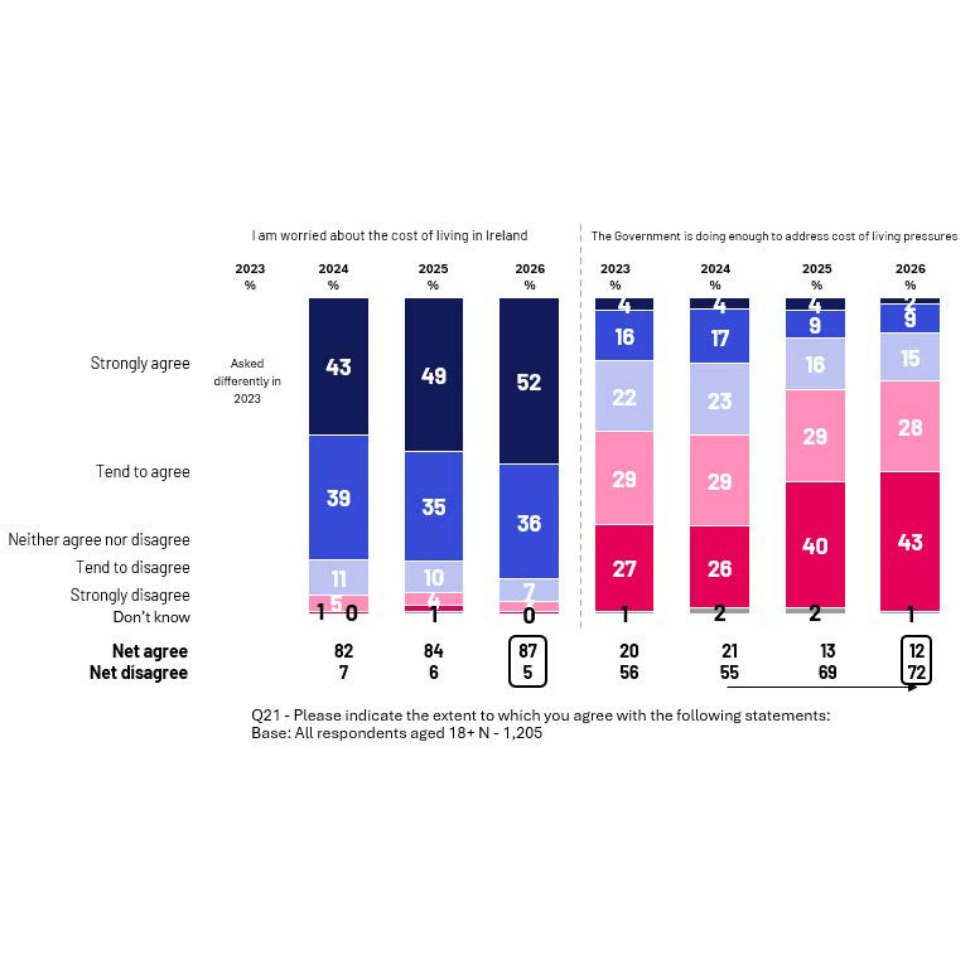
These findings illustrate a continuing disconnect between Ireland’s strong headline economic performance and the economic security experienced by many households.
Housing Ireland’s housing and homelessness crisis continued to deepen during the reporting period. As of July 2026, the number of people living in State-funded emergency accommodation reached 17,527, an increase of 9.1% over the previous 12 months.52 Official homelessness figures do not capture the full scale of housing exclusion, as they exclude people sleeping rough, staying temporarily with family or friends, living in vehicles or other insecure accommodation, and people staying in domestic violence refuges or IPAS accommodation.
The publication of Delivering Homes, Building Communities 2025–2030 in November 2025 established a target of delivering 300,000 new homes by 2030.53 Increased housing supply is essential, and the new plan represents an important policy development. However, the removal of annual delivery targets makes it more difficult to assess progress and accountability, including against Ireland’s commitment under the 2021 Lisbon Declaration to work towards ending homelessness by 2030.
The Residential Tenancies Act 2026 introduced significant changes for new tenancies from March 2026, including provision for rents to reset between tenancies or after six years. Following the introduction of the new regime, eviction notices increased sharply.54 The changes also create greater divergence between the security and rental conditions experienced by existing and new tenants.
Further significant changes were introduced through the Housing and Residential Tenancies (Miscellaneous Provisions) Bill 2026. Positively, provision has been made for a system of appeals concerning social housing decisions. However, we have raised concerns regarding whether the proposed appeals mechanism provides sufficient procedural safeguards, including access to legal advice and assistance and opportunities for oral hearings. We also raised serious concerns regarding the introduction of lawful and habitual residency requirements affecting eligibility for social housing support and accommodation for homeless persons, including the absence of exemptions for victims of trafficking and domestic, sexual and gender-based violence. The legislative process surrounding the Bill also raised concerns regarding the limited opportunity for scrutiny of the proposed measures, another example of increasingly rushed law-making that undermines the rule of law. We wrote to the Minister for Housing, Local Government and Heritage in June55 and July 202656 outlining these concerns.
These concerns were reinforced internationally in August 2026, when the UN Special Rapporteur on the right to adequate housing wrote to Ireland regarding the legislation. The Special Rapporteur echoed our concerns in warning that the proposed residency requirements could have severe consequences for victims of trafficking, people who have experienced domestic and gender-based violence, migrant communities and other vulnerable groups, including an increased risk of rough sleeping.57
Ireland has also yet to accept Article 31 of the Revised European Social Charter, which protects the right to housing. In October 2025, we wrote to the European Committee of Social Rights challenging the State’s position that the absence of an express constitutional right to housing prevents acceptance of Article 31.58 We have previously recommended constitutional recognition of economic, social and cultural rights,59 but constitutional reform is not a prerequisite to accepting Article 31.
Labour Rights
There were some positive developments in labour rights and social protection during the year, although significant gaps remain in relation to low pay and collective bargaining. The national minimum wage increased to €14.15 per hour from 1 January 2026 following a recommendation of the Low Pay Commission. However, the statutory minimum remains below the estimated Living Wage of €15.40 per hour,60 while lower statutory minimum wage rates continue to apply to workers under the age of 20.
The introduction of pension auto-enrolment from January 2026 represents a welcome expansion of social protection for workers in retirement. Its implementation should continue to be assessed from an equality perspective, including its impact on women and people with interrupted or lower-paid employment histories. This reflects issues previously identified in research prepared by TASC for the National Women’s Council, funded by IHREC. 61
The publication of the Action Plan to Promote Collective Bargaining was also a positive development and followed requirements under the EU Directive on Adequate Minimum Wages.62 However, its predominantly voluntary approach does not address the continuing legislative gap arising from the absence of a statutory obligation on employers to recognise trade unions for collective bargaining purposes.
Poverty and social inclusion
Two significant new policy frameworks were published during the reporting period. The Roadmap for Social Inclusion 2026–2030 was launched in May 2026,63 while the European Commission published the EU’s first Anti-Poverty Strategy.64 These developments provide an opportunity for a more coordinated approach to reducing poverty and social exclusion in Ireland.
However, significant material deprivation persists. The European Commission’s 2026 Country Report on Ireland identified a substantial increase in energy poverty among vulnerable households, rising from 6.8% in 2020 to 14.8% in 2024.65 This trend is consistent with the high levels of concern about household energy costs recorded in IHREC’s Annual Poll 2026.
Cost-of-living pressures also have wider implications for social cohesion, as demonstrated by the fuel protests in April 2026. Attempts by far-right actors, many from outside of Ireland, to redirect legitimate economic grievances towards anti-migrant narratives illustrated the risk that economic insecurities can be exploited to deepen social division.66 Effectively addressing poverty and economic inequality is therefore important not only to the enjoyment of economic and social rights in their right, but also to overall social cohesion and confidence in our democratic institutions.
52 RTE News, 28 August 2026, Slight rise in number of homeless in July to 17,527
53 Delivering Homes, Building Communities 2025-2030
54 RTE, 14 May 2026, 50% rise in evictions as new rent rules came into force.
55 IHREC, 9 June 2026, Letter to Minister Browne on the Housing and Residential Tenancies (Miscellaneous Provisions) Bull 2026.
56 IHREC, 8 July 2026, Letter to Minister Browne on the Government report stage amendments of the Housing and Residential Tenancies (miscellaneous Provisions) Bill 2026
57 Communication to Ireland IRL 1/2026
58 IHREC, 14 October 2025, Letter to President of the European Committee of Social Rights on the Non-Accepted Provisions of the European Social Charter
59 IHREC, February 2023, Policy Statement: The Incorporation of Economic, Social and Cultural Rights into the Irish Constitution
61 Tasc and NWC, December 2024, Still Stuck in the Gap: Pensions Auto-enrolment from a gender and care lens
62 IHREC, June 2026, Parallel report on implementation of the revised European Social Charter
63 Department of Social Protection, 22 May 2026, Roadmap for Social Inclusion 2026-2030
64 European Commission, EU Anti-Poverty Strategy
65 European Commission Ireland 2026 Country Report
66 Gardaí have found foreign actors using social media to 'amplify' far-right content in Ireland (May 2025); How Ireland's far-right movement got involved in the fuel protests and tried to hijack them (April 2026); Disorder in Belfast ‘stoked by those who would struggle to find the city on a map’ | UK news | The Guardian (June 2026);
Racism, hate and social cohesion
Public support for equal treatment remains strong, but racism continues to be experienced disproportionately by non-Irish and minoritised communities. During the 2025–2026 reporting period, we observed hate-motivated incidents, persistent structural discrimination against Traveller and Roma communities, and significant weaknesses in the implementation of Ireland’s anti-racism and hate-speech framework.
According to IHREC’s Annual Poll 2026, 12% of respondents reported experiencing racism in the past 12 months, down two points from 2025. However, experiences of racism are more prevalent among particular groups: 25% of non-Irish respondents and 46% of non-white respondents reported personally experiencing racism. Nearly one in three of all respondents (32%) reported witnessing racism during the previous year. This increased to 42% among non-Irish respondents and 62% among non-white respondents.
These findings demonstrate that, while the overall incidence reported by the population has fallen slightly, racism remains a significant and disproportionately experienced feature of life for minority communities in Ireland.
Racist and hate-motivated incidents
Reports of racist and hate-motivated incidents remained a serious concern during the reporting period. Data from An Garda Síochána shows that hate crimes and hate related increased by 15%, to 780 reported incidents, in 2025 compared to 2024.67 Racist attacks against people of Indian and South Asian origin also received significant public attention, prompting protests from the Indian community and warnings from the Indian Embassy to its citizens in Ireland,68 while the death of Yves Sakila, a man of Congolese origin, in an incident involving private security in May 2026, prompted renewed public discussion about racism and the experiences of Black and minority communities in Ireland.69
Traveller and Roma
Racism in Irish society is not only targeted towards more recent migrants to Ireland. There is long-standing and deep-rooted discrimination against Travellers and Roma across many areas of life in Ireland, as illustrated by the publication in October 2025 of a report on Roma and Traveller rights across 13 European countries, including Ireland. The findings are stark: 75% of Travellers and 60% of Roma in Ireland reported experiencing discrimination in the previous year, while 50% of Travellers and 41% of Roma reported experiencing at least one form of hate-motivated harassment over the past 12 months.70
In November 2025, we highlighted the continuing normalisation of discrimination against Traveller and Roma people and the need for Irish society to recognise it as a form of racism.71 Research and policy work undertaken during the year also highlighted persistent barriers in areas including access to goods and services and employment. Our review of section 19 of the Intoxicating Liquor Act identified ongoing concerns regarding discrimination experienced by Travellers in licensed premises,72 while our guidance on inclusive employment for Traveller and Roma people seeks to address persistent barriers to participation in the labour market.73
The experience of Senator Eileen Flynn illustrated the intersection between racism, misogyny and abuse directed at minority voices in public life. In April 2026, Senator Flynn reported particularly severe online abuse following comments she made regarding the fuel protests74. The racialised and gendered nature of that abuse reflects wider concerns regarding the environment faced by women and members of minority communities participating in political and public debate.
National Action Plan Against Racism
February 2026 saw the publication of the first annual report of the Special Rapporteur on Racial Equality and Racism, providing an important independent assessment of implementation of the National Action Plan Against Racism (NAPAR). The establishment of independent monitoring is welcome. However, the Special Rapporteur identified significant weaknesses in implementation, including fragmented delivery, inadequate resourcing and weaknesses in accountability. Seven Government Departments did not provide reports for the monitoring exercise.75
NAPAR is due to conclude in 2027. With limited time remaining in the current Strategy, stronger implementation and accountability will be necessary if its objectives are to be realised. Planning for an effective successor framework should also begin in sufficient time to avoid a gap between national anti-racism strategies.
European Commission against Racism and Intolerance
The European Commission against Racism and Intolerance (ECRI) published its sixth monitoring report on Ireland in October 2025. The review focused on equality and access to rights, hate speech and hate-motivated violence, and integration and inclusion. ECRI made 17 recommendations to Ireland, including two priority recommendations requiring follow-up within two years. These recommendations concern strengthening legislation to combat hate speech and improving the availability and quality of accommodation for international protection applicants and beneficiaries.76 The findings reinforce concerns identified elsewhere in this report regarding both Ireland’s response to hate speech and the conditions experienced by people seeking international protection.
Hate crime and hate speech
There has been limited progress in strengthening Ireland’s legislative response to hate speech, despite a commitment in the Programme for Government to reform the Prohibition of Incitement to Hatred Act 1989. During the reporting period, the Minister for Justice, Home Affairs and Migration indicated that reform of the legislation was no longer considered necessary. This represents a significant change in approach at a time when both ECRI and the UN Human Rights Committee have made priority recommendations to Ireland to reform our hate speech legislation.77
Robust implementation of the Criminal Justice (Hate Offences) Act 2024 also remains an important issue. An April 2026 post-enactment report identified limited awareness among marginalised communities of the protections provided by the new legislation.78 Effective hate-crime legislation depends not only on enactment, but on people affected by hate crime understanding the protections available to them and having confidence in reporting and enforcement mechanisms.
Gendered hate and violence against women and LGBTQI+ people
Misogyny, homophobia and transphobia also contribute towards an environment in which people are targeted because of their identity, particularly in online spaces and in public life. Although these forms of hostility are distinct, they can interest and reinforce one another, particularly when individuals who belong to more than one marginalised group are targeted.
Gendered and racialised hostility is increasingly visible in public discourse. Women in public life face attacks directed not at their political views, but at their gender and identity, as demonstrated by the attacks on Senator Eileen Flynn, the experiences of several female councillors from minority backgrounds,79 and a targeted campaign of harassment directed at over 70 female councillors across Ireland in the first half of 2026.80 Research published in 2026 shows electoral candidates from minority backgrounds face disproportionate levels of abuse and intimidation,81 while 96% of female Oireachtas members that responded to an anonymous survey have experienced online violence and two-thirds have changed their social media behaviour as a result. 82 This type of abuse has a chilling effect on women’s and racialised minorities equal participation in public life. On the other end of the spectrum, Domestic, Sexual, and Gender-Based Violence (DSGBV) remains a manifestation of gender inequality and hostility towards women in private life. Data from An Garda Síochána shows a 10% increase in domestic abuse reports in the first four months of 2026 as compared to 2025.83
Homophobia and transphobia are also prevalent. Hate crime statistics show that 8% of reported incidents in 2025 were recorded as having an anti-sexual orientation motive,84 while research published in February 2026 documents numerous incidents targeted at the LGBTQI+ community in Ireland in 2025, including a marriage equality anniversary event having to be relocated after online threats, an assault of two drag performers in Cork, and a suspected homophobic attack in Limerick.85
Taken together, these trends have implications beyond the harm experienced by individual victims. Where women, LGBTQI+ peoples and members of racialised minorities face hostility, intimidation or abuse because of their identity, their ability to participate fully and equally in public life is undermined. Tackling group-based hostility is therefore central to maintaining an inclusive, cohesive, and resilient democratic society. However, the slow implementation of the NAPAR, uncertainty regarding reform of hate-speech legislation, continuing reports of racism and hate-motivated incidents, and raising violence against women and LGBTQI+ people indicate that Ireland’s institutional response has not yet matched the scale of the challenge.
67 An Garda Síochána, 14 August 2026, An Garda Síochána Release Hate Crime and Hate Related Incidents Statistics for 2025
68 Info Migrants, 14 August 2025, Ireland: Growing numbers of attacks on Indians and South Asian migrants causing consternation
69 The Guardian, 3 June 2026, How the death of Yves Sakila exposes Ireland’s deeply rooted racism problem.
70 Fundamental Rights Agency, 2025, Rights of Roma and Travellers in 13 European Countries: Perspectives from the Roma Survey 2024
71 Irish Examiner, 11 November 2025, We need to acknowledge our structural problem with racism.
72 IHREC, November 2025, Review of Section 19 of the Intoxicating Liquor Act
73 IHREC, November 2025, Traveller and Roma Inclusive Employment Employer Guide
74 Senator Eileen Flynn says she has faced worst online abuse and hate yet in past week (April 2026)
75 Annual Report of the Special Rapporteur on Racism Equality and Racism, Ireland, December 2025
76 ECRI Report on Ireland (sixth monitoring cycle)
77 Human Rights Committee, International Covenant on Civil and Political Rights, Concluding observations on the fifth periodic report of Ireland, January 2023
78 Irish Examiner, 13 April 2026, Marginalised don’t know what protections hate crime legislation provides, report says
79 Irish Times, 24 January 2026, Meath councillor ‘spat on’ during alleged racial attack
80 RTE News, 30 July 2026, Concern after harassment of up to 70 female councillors
81 Hope and Courage Collective, May 2026, Galway and Dublin By-election 2026 – Smears, Harassment and Threats to Election Integrity.
82 Women For Election, 2026, Country Report on Gender-Based Violence against Women Politicians in Ireland
83 Public Policy IE, 4 August 2026, An Update on Ireland’s Efforts to Combat Domestic, Sexual and Gender-based Violence
84 An Garda Síochána, 14 August 2026, An Garda Síochána Release Hate Crime and Hate Related Incidents Statistics for 2025
85 ILGA Europe Annual Review of the Human Rights Situation of LGBTI People Covering the Period of January to December 2025: Ireland.
Migration, asylum, and trafficking
Migration and asylum policy underwent major change during 2025–2026, with increasing emphasis on accelerated procedures, returns and migration control. These reforms took place against persistent accommodation pressures and significant gaps in legal safeguards and independent oversight. In parallel, progress on identifying and protecting victims of trafficking remained inadequate despite new EU obligations.
Migration and asylum remained a prominent issue in Irish political and public debate during the reporting period. According to IHREC’s Annual Poll 2026, immigration control was the fourth most commonly identified issue of concern, behind cost of living, housing and healthcare.
At the same time, there remains strong public support for the principle of equal treatment. Some 84% of respondents agreed that everybody should be treated equally regardless of where they come from. However, a lower proportion (48%) believe that Irish people welcome diversity and interculturalism, indicating a significant gap between support for equality in principle and perceptions of social inclusion in practice.
Attitudes towards diversity
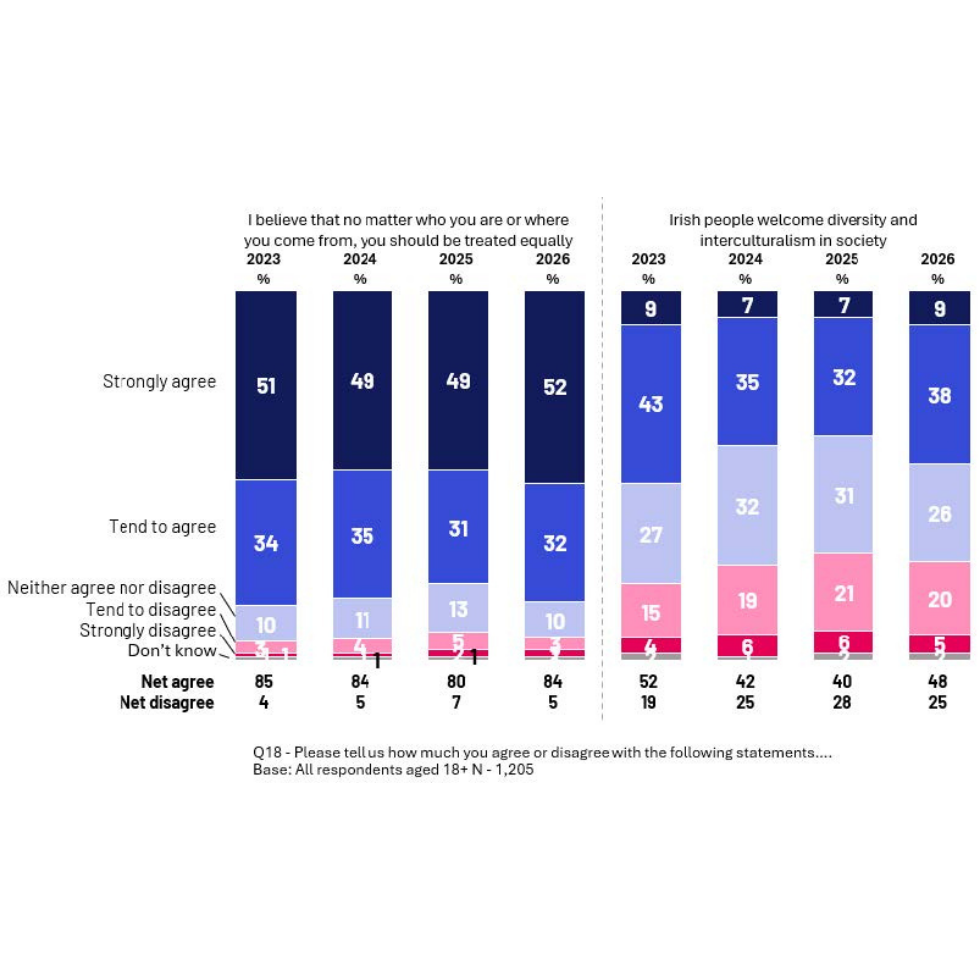
Public perceptions of refugees and people seeking international protection were similarly mixed. Almost three quarters of respondents (74%) agreed that refugees and asylum seekers experience racism and discrimination, while 49% believed they have access to adequate accommodation and 47% believed they are treated fairly.
Misperceptions about migration continue to influence public debate. Research published by the Economic and Social Research Institute (ESRI) in January 2026 found that public perceptions of immigration are frequently inaccurate and systematically biased.86 Further ESRI research published in June 2026 found no evidence that migrants are more likely than Irish-born people to receive social welfare payments.87
These findings are significant in a context where misinformation about migration and access to public services has contributed to social tension. Anti-immigration protests continued during the reporting period, including serious disorder outside international protection accommodation in West Dublin in October 2025. There were also attacks on accommodation housing people seeking protection, including an arson attack on a centre in Drogheda in which residents, including children, had to be rescued by firefighters. Anti-migrant and refugee mobilisation in Ireland has evolved alongside incidents of racist and anti-immigrant disorder across the border in Belfast, increasing the risk of spill-over effects in the Republic.88
Reception and Accommodation for International Protection Beneficiaries and Applicants
Persistent shortages of suitable accommodation continued to undermine the State’s ability to provide stable and appropriate housing for people seeking or granted international protection. In May 2026, Government approved changes to accommodation arrangements for people from Ukraine benefiting from Temporary Protection, including the phased withdrawal of State-contracted accommodation for approximately 16,000 people by March 2027.89 These changes create a significant risk of additional pressure on an already constrained housing and homelessness system.90
People granted refugee status, subsidiary protection or permission to remain are also required to leave International Protection Accommodation Services (IPAS) accommodation. However, shortages in the private rental and social housing sectors mean that many are unable to secure alternative accommodation. Some consequently remain in IPAS centres beyond the period for which those centres are intended, 91 while others enter emergency homeless accommodation, often disrupting employment, education and childcare arrangements. There are an estimated 5,000 people with permission to remain in Ireland that are unable to leave IPAS accommodation as of December 2025.92
The European Commission against Racism and Intolerance identified these problems as a priority issue in its 2025 monitoring report on Ireland, calling on the State to take prompt and effective steps to improve the availability and quality of safe accommodation for international protection applicants and beneficiaries.
As discussed in the section on socio-economic rights, changes to eligibility for social housing and homelessness supports also raise particular concerns for migrants, victims of trafficking and other people whose residence status may prevent them from satisfying new eligibility requirements.
International Protection Act 2026
The International Protection Act 2026 introduced extensive changes to Ireland’s asylum system in order to implement the EU Pact on Migration and Asylum. We have raised significant concerns regarding aspects of the new framework, including restrictions on access to legal advice, the introduction of the legal fiction of “non-entry”, and the expanded use of detention and forms of de facto detention for people seeking international protection.93
These developments are particularly concerning in the context of Ireland’s continuing failure to ratify the Optional Protocol to the UN Convention against Torture (OPCAT). As discussed earlier in this report, Ireland has yet to establish the comprehensive system of independent monitoring of places of deprivation of liberty required under OPCAT. The expansion of immigration detention therefore risks creating new forms of deprivation of liberty without the independent oversight framework envisaged under international human rights law.
The increased use of charter deportation flights also heightens the importance of independent monitoring. Ten chartered deportation flights took place between February 2025 and June 2026. Such operations involve people being deprived of their liberty and returned from the State and therefore require robust safeguards and independent oversight.
Concerns regarding return policy also arose at European level. In October 2025, Ireland joined other EU Member States in calling for greater cooperation on voluntary and forced returns to Afghanistan.94 Subsequent engagement between the European Commission and Taliban authorities raised difficult questions concerning the compatibility of return policies with the principle of non-refoulement and the human rights situation in Afghanistan.
Ireland must ensure that migration control and return policies operate consistently with its obligations under EU and international law, including the absolute prohibition on returning individuals to circumstances in which they face persecution, torture or other serious harm.
Anti-Human Trafficking
Progress in strengthening Ireland’s response to human trafficking was extremely limited during the reporting period, with significant gaps remaining in the identification, accommodation and protection of victims. The amended EU Anti-Trafficking Directive introduces enhanced obligations on Member States in relation to the prevention and prosecution of trafficking and the identification and protection of victims. However, Ireland, yet again, failed to meet its transposition deadline, on 15 July 2026. The approach proposed through the General Scheme of the Criminal Law (Sexual Offences, Domestic Violence and International Instruments) Bill 2025 also raises concerns that there will not be full implementation of the amended Directive and therefore not fully address wider deficiencies in Ireland’s trafficking framework.
The Criminal Law (Sexual Offences and Human Trafficking) Act 2024 established a statutory National Referral Mechanism (NRM) intended to improve the identification of victims and their access to protection and supports. However, the relevant provisions had still not been commenced by the end of the reporting period.
As a result, significant weaknesses remain in existing procedures for identifying victims, including concerns regarding transparency and consistency. Engagement between the responsible Department and civil society organisations has also reduced, with no stakeholder forum held during 2025 despite such meetings having taken place regularly in previous years.
Accommodation for victims of trafficking remains a particular concern. Service providers have reported instances in which victims, particularly those outside the international protection process, have been unable to access appropriate accommodation. The specialist accommodation established for victims in 2023 remains a small-scale pilot, with only eight beds and restrictive eligibility criteria.
The implementation of the EU Pact on Migration and Asylum presents additional risks. The International Protection Act 2026 does not adequately provide for the identification and specific needs of victims of trafficking within the international protection system, including the interaction between accelerated procedures, detention and trafficking identification.
Taken together, delays in commencing the National Referral Mechanism, failure to meet the EU transposition deadline, inadequate accommodation and weaknesses in victim identification indicate that Ireland has yet to establish a consistently victim-centred response to human trafficking.95
86 ESRI, January 2026, The role of misperceptions in attitudes to immigration.
87 ESRI, June 2026, Social transfers utilisation among migrants and Irish-born in Ireland
88 The Guardian, 8 August 2026, The night Belfast burned: how the Northern Ireland race riots unfolded.
89 Department of Justice, Home Affairs and Migration, 26 May 2026, Minister for Justice, Home Affairs and Migration Jim O’Callaghan and Minister of State for Migration Colm Brophy secure Government approval for new measures in relation to Ukrainian citizens with Temporary Protection status.
90 Irish Independent, 25 May 2026, Calls for Justice Minister to spell out supports for councils facing surge in emergency housing demands
91 BreakingNews.ie, 27 May 2026, Growing amount of people staying in direct provision as they cannot find accommodation – NGO
92 Submission by the United Nations High Commissioner for Refugees For the Office of the High Commissioner for Human Rights’ Compilation Report Universal Periodic Review: 4th Cycle, 53rd Session, Ireland
93 IHREC, January 2026, Overview of International Protection Bill 2026
94 16 October 2026, Joint letter from the undersigned ministers on voluntary and forced return to Afghanistan This letter was signed by the Minister for Justice, Home Affairs and Migration.
95 IHREC, 8 June 2026, IHREC Letter to the Convention on Action against Trafficking in Human Beings (GRETA)
Disability
There was significant policy and legislative activity on disability rights during 2025–2026, including a new national strategy and reviews of key legislation. However, persistent gaps in implementation, including in community-based supports and measures to enable independent living, accessibility and safeguarding prevent the full realisation of UNCRPD rights.
According to IHREC’s Annual Poll 2026, 40% of respondents reported having at least one disability / impairment,96 with chronic conditions and mobility difficulties among the most commonly reported. Mental health and psychosocial difficulties were reported by 16% of respondents. Among respondents reporting having a disability / impairment, 16% said they had personally experienced discrimination during the previous 12 months. Across all respondents, 12% reported witnessing disability discrimination, a decrease of three percentage points compared with 2025. Younger respondents were considerably more likely to report witnessing disability discrimination than older age groups.
These findings provide an important context for the significant policy and legislative activity on disability rights during the year. While important frameworks for reform are now in place, substantial gaps remain between policy commitments and the full realisation in practice of the rights guaranteed under the UN Convention on the Rights of Persons with Disabilities (UNCRPD).
UNCRPD
Ireland will undergo its first review by the UN Committee on the Rights of Persons with Disabilities in 2027. In preparation for the review, we submitted a List of Issues report to the Committee, highlighting persistent barriers to the full realisation of disabled people’s rights, including a legislative framework that does not align with the UNCRPD and does not adequately safeguard individuals at risk and/or deprived of their liberty, shortcomings in the operation of the Assisted
Decision-Making (Capacity) Act 2015, delays in policy development and weaknesses in oversight.97 The State submitted its response to the Committee’s List of Issues in August 2026, providing updated information across a wide range of policy areas.98 The Committee’s review of Ireland in 2027 will provide an important independent assessment of the extent to which Ireland has translated its commitments under the UNCRPD into practice.
National disability strategy
A major domestic development was the publication in September 2025 of the National Human Rights Strategy for Disabled People 2025–2030, together with an Action Plan for 2025–2026. 99 The Strategy establishes a whole-of-government framework for implementation of the UNCRPD, and implementation structures have subsequently been established, with the first biannual progress report published in July 2026. Under the Strategy, the Government progressed a consultation in relation to a cost of disability payment and intends to progress initiatives in the coming period, starting most likely with budget 2027. Irish disability advocacy groups have continued to press the State for major financial reforms to support the lives of disabled people.
The publication of the Strategy is welcome. However, important UNCRPD rights, including access to justice, are not adequately addressed, while some targets in the accompanying Action Plan lack the scale or specificity required to deliver substantive change.100 Effective implementation will require measurable outcomes, sufficient resources and meaningful participation by Disabled Persons’ Organisations.
Review of the Disability Act 2005
The Government also commenced a review of the Disability Act 2005 (as amended) in June 2026, as a first step in delivering on the commitment for reform of the Disability Act made in the National Human Rights Strategy for Disabled People 2025-2030.101 The review is particularly welcome as the Act has not been updated in over 20 years and predates the UNCRPD. Comprehensive reform of the legislation provides an important opportunity to align Ireland’s disability framework with the UNCRPD. The closing date for submissions for the review is 9 October 2026.
In February 2026, we published a report reviewing the compliance of the 2005 Act with the UNCRPD.102 The report’s analysis of the Act’s compliance with the requirements of the CRPD showed considerable gaps in compliance across the Act. These include, but are not limited to, the definition of disability, the absence of a legal right to receive services or supports, limiting accessibility requirements to public bodies, and a lack of recourse to the courts to enforce rights.
The General Scheme of the Disability (Amendment) Bill 2025 was published in February 2026, focusing primarily on reform of the Assessment of Need process. While reform of that process is urgently required, we have raised concerns that piecemeal amendment should not substitute for the wider review necessary to achieve full UNCRPD compliance.103
Reform of capacity law
There was legislative change concerning the transition away from the system of wardship, as provided for by the Assisted Decision-Making (Capacity) Act 2015. The Assisted Decision-Making (Capacity) (Amendment) Act 2026 was introduced to provide legal certainty for people who had not exited wardship as the April 2026 deadline for the abolition of wardship as approaching. The Act allows the High Court, on a case-by-case basis, to extend the period for reviewing and discharging remaining adult wards of court, while requiring all remaining cases to be addressed by October 2027. 104 We have expressed concern that the continuation of wardship beyond the original April 2026 deadline is inconsistent with Ireland’s obligations under the UNCRPD.105 The transition from substitute decision-making to supported decision-making should be completed as quickly as possible while ensuring that appropriate supports are available to the individuals affected.
Independent living, housing and safeguarding
Significant barriers remain to disabled people living independently and participating in their communities. Shortages of accessible housing, community-based supports and appropriate services can leave disabled people with little effective choice about where and with whom they live, contributing to continued reliance on institutional forms of care. Approximately 1,200 disabled people under the age of 65 continue to live in nursing homes primarily designed for older people. 106 This raises significant concerns regarding Ireland’s obligations under Article 19 of the UNCRPD, which protects the right of disabled people to live independently and be included in the community.
Safeguarding arrangements also remain inadequate. Available inspection data have identified many instances of violence against persons with disabilities resident in disability services, while restrictive practices remain widely used.107
These concerns are compounded by Ireland’s continuing failure to ratify OPCAT and establish a comprehensive system of independent preventive monitoring. As discussed earlier in this report, an effective National Preventive Mechanism should encompass settings in which people may be deprived of their liberty, including relevant health and social-care environments.
Progress towards deinstitutionalisation requires more than the closure of institutional settings. Disabled people must have access to accessible housing, personal assistance, healthcare and community-based supports that make independent living a genuine choice.
Cost of Disability
The additional financial costs associated with disability remain a significant barrier to equality. Disability-related costs can represent more than half of a household’s disposable income in some circumstances and increase substantially according to the severity of disability. Existing disability-related income supports do not fully meet these additional costs.108 Against this background, the Government’s consultation on the introduction of a permanent Annual Cost of
Disability Support Payment is a welcome development. IHREC and our Disability Advisory Committee, in welcoming the consultation, have called for sustained and meaningful engagement with disabled people as this progresses, with adequate timeframes for engagement and with particular regard for the voices and perspectives that are often not heard, including people who do not communicate linguistically.109
96 The poll asked “Do you have any of the following long lasting conditions or difficulties? and provided a list of seven categories.
97 IHREC, 27 August 2025, Ireland and the United Nations Convention on the Rights of Persons with Disabilities.
98 Department of Children, Disability and Equality, 11 August 2026, Minister Foley and Minister Higgins submit Ireland’s reply to the UN Committee on the Rights of Persons with Disabilities.
99 National Human Rights Strategy for Disabled People 2025-2030
100 IHREC, 3 September 2025, Publication of Disability Strategy a Significant Step Forward – But further detail on implementation urgently needed
101 Department of Children, Disability and Equality, 8 June 2026, 20 year old Disability Act to be reviewed.
102 IHREC, February 2026, Review of the compliance of the Disability Act 2005 with the UN Convention on the Rights of Persons with Disabilities
103 IHREC, Letter from IHREC to the Minister of State regarding the General Scheme for Disability (Amendment) Bill 2025
104 Assisted Decision-Making (Capacity) (Amendment) Act 2026
105 IHREC, 19 March 2026, Letter to the Department of Children, Disability and Equality on the Draft Heads and General Scheme of the Assisted Decision-Making (Capacity) (Amendment) Bill 2026.
106 Irish Independent, 3 March 2026, Revealed: More than 1,200 people under 65 still living in nursing homes.
107 IHREC, 6 January 2026, Letter to Minister of State Emer Higgins on EUFRA research into violence against persons with disabilities in institutions
108 ESRI, 13 March 2025, Adjusting estimates of poverty for the cost of disability.
109 IHREC, 5 May 2026, Correspondence from IHREC to the Department of Social Protection regarding the ‘cost of disability’ consultation
Looking Ahead
The coming year will be an important period for human rights and equality in Ireland. A number of long-awaited reforms are expected to progress, while Ireland will also undergo significant international scrutiny. The key test will not necessarily be in the number of strategies, action plans or pieces of legislation adopted, but whether they produce measurable improvements in the enjoyment of rights in practice.
Based on developments over the past year, we set out the following five priority areas that the Government should endeavour to make meaningful progress in.
1. Progress comprehensive reform of Ireland’s equality legislation
The Government should prioritise the publication and enactment of the Equality (Miscellaneous Provisions) Bill and use the opportunity to deliver comprehensive reform of Ireland’s equality framework, including protection against socio-economic discrimination and intersecting forms of discrimination, in line with the priority recommendation received from the CEDAW Committee.110 This should also be aligned with the full implementation of the EU Standards for Equality Bodies.
110 UN Convention on the Elimination of All Forms of Discrimination Against Women Concluding observations on the eight periodic report of Ireland.
2. Develop a comprehensive national response to hate
IHREC has developed a Policy Statement on Hate, setting out 24 recommendations to Government to comprehensively prevent, counter and respond to hate.111 In line with these recommendations, the Government should develop and implement, in collaboration with communities affected by hate, a national strategy and action plan to prevent and respond to hate. This should provide a coordinated framework for legal and non-legal measures, with clear responsibilities, measurable outcomes and robust independent monitoring. As part of this framework, the State should fully implement the Criminal Justice (Hate Offences) Act 2024 and renew efforts to comprehensively reform laws prohibiting incitement to hatred in line with the priority recommendation received from the European Commission against Racism and Intolerance and the United Nations Human Rights Council,112 while striking an appropriate balance with freedom of expression.
111 IHREC, September 2026, Policy Statement on Hate.
112 ECRI Report on Ireland (sixth monitoring cycle) and Human Rights Committee, International Covenant on Civil and Political Rights, Concluding observations on the fifth periodic report of Ireland, January 2023
3. Strengthen the response to violence against women
In developing the successor to the National Strategy on DSGBV, which expires at the end of 2026, the Government should strengthen its response to violence against women through delivery of a timely, comprehensive, adequately resourced and measurable framework for prevention of, protection from, and accountability for DSGBV. Effective measures to address gendered abuse and intimidation of women in public life should also be developed.
4. Improve accommodation for people seeking and granted international protection
The Government should implement the European Commission against Racism and Intolerance priority recommendation to take prompt and effective action to improve the availability and quality of safe accommodation for international protection applicants and beneficiaries, including addressing the barriers preventing people who have received protection status from leaving IPAS accommodation.
5. Remove barriers to redress for survivors of institutional abuse
The Government should remove all outstanding arbitrary barriers to effective redress for survivors of institutional abuse in Mother and Baby Homes, Magdalene Laundries and other residential institutions, in line with the priority recommendation received from the CEDAW Committee. This includes removing restrictive eligibility criteria, length of stay requirements, improved promotion of the redress schemes, particularly abroad, and improved access to records. The Government must also fully implement the O’Keeffe v Ireland judgement of the European Court of European Rights.
Key milestones to watch in 2026-2027
- Ireland will undergo significant international human rights scrutiny over the coming year:
The State’s fourth Universal Periodic Review will take place on 10 November 2026, providing an opportunity for UN Member States to assess Ireland’s overall human rights record and make recommendations for further action.
Ireland will also undergo its first substantive review by the UN Committee on the Rights of Persons with Disabilities in 2027. This will provide an important independent assessment of progress in implementing the UNCRPD and of persistent barriers identified by disabled people and their representative organisations.
Ireland is due to undergo a review under the UN Convention on the Elimination of Racial Discrimination in 2027.
The Council of Europe’s Group of Experts on Action against Trafficking in Human Beings (GRETA) is expected to publish its fourth evaluation of Ireland, providing further scrutiny of victim identification, accommodation, support and the implementation of Ireland’s National Referral Mechanism.
The report of the UN Special Rapporteur on the human right to a clean, healthy and sustainable environment, following her 2026 visit to Ireland, is expected to be presented to the Human Rights Council in March 2027.
Several important domestic policy developments are also expected:
- A new National Action Plan on Business and Human Rights is due by the end of 2026, while new action plans are expected under the National LGBTIQ+ Inclusion Strategy and the National Traveller and Roma Inclusion Strategy in 2027. A new Domestic, Sexual and Gender-Based Violence Strategy is also anticipated in 2027. The successor to the Migrant Integration Strategy is due and the five-year National Action Plan Against Racism concludes in 2027.
The Inspection of Places of Detention Bill remains particularly significant. Its enactment would provide the statutory basis for Ireland to complete OPCAT ratification and establish the National Preventive Mechanism system, closing a long-standing gap in the independent monitoring of places where people are deprived of their liberty.
The coming year will therefore provide important opportunities to address many of the implementation gaps identified throughout this report. Ireland has well-developed human rights and equality commitments and an increasingly extensive policy framework. The challenge now is to ensure that those commitments are translated consistently into legislation, implementation, accountability and tangible improvements in people’s lives.
Anticipated IHREC publications in 2026-2027:
- Child Trafficking Report
- Human Rights and Equality Budgeting Guide
- Protection, support and solidarity for Human Rights Defenders defending equality rights. An exploratory study.
- Rule of Law and the Oireachtas Report
- Guidance and Toolbox on Equality and Human Rights Impact Assessments under Section 42 of the IHREC Act including a Human Rights and Equality Impact
- Assessment of Legislation resource
- Statutory Review of Section 18 of the Mother and Baby Institutions Payment Scheme Act 2023
Download PDF
Download Key Developments in Human Rights and Equality for Ireland 2025-2026